 6e2ba61d95
|
5 years ago | |
|---|---|---|
| src | 5 years ago | |
| .gitignore | 5 years ago | |
| LICENSE | 5 years ago | |
| README.md | 5 years ago | |
| RWKV-vs-MHA.png | 5 years ago | |
| train.py | 5 years ago | |

README.md
RWKV-LM
We propose the RWKV language model, with alternating time-mix and channel-mix layers:
-
The R, K, V are generated by linear transforms of input, and W is parameter. The idea of RWKV is to decompose attention into R(target) * W(src, target) * K(src). So we can call R "receptance", and sigmoid means it's in 0~1 range.
-
The Time-mix is similar to AFT (https://arxiv.org/abs/2105.14103). There are two differences.
(1) We changed the normalization (denominator). For masked language models, we define:
(2) We decompose W_{t,u,c} and introduce multi-head W (here h is the corresponding head of c):
Moreover we multiply the final output of Time-mix layer by γ(t). The reason for the α β γ factors, is because the context size is smaller when t is small, and this can be compensated using the α β γ factors.
-
The Channel-mix is similar to GeGLU (https://arxiv.org/abs/2002.05202) with an extra R factor.
-
Finally, we add extra time-shift mixing as in (https://github.com/BlinkDL/minGPT-tuned). You can try reducing the amt of time-mixing in upper layers of deep models.
the time-shift mixing means explicitly using both (half channel of this token) & (half channel of prev token) to generate all vectors.
i find divide by 2 and shift-1 is the best. i looked at the weights and found you may want to use less mixing in higher layers.
here is my theory:
when you train a GPT, the hidden representation of a token has to accomplish two different objects:
-
predict the next token. sometimes this is easy (obvious next token).
-
collect all prev ctx info so later token can use it. this is always hard.
the time_shifted channels can focus on (2). so we have good propagation of info. it's like some kind of residual connection.
you can use time_shift in usual QKV self-attention too. when i studied the weights, i found V really likes time_shift. less so for Q. makes sense if you think abt it.
p.s. There is aother MHA_pro model in this repo with strong performance. Give it a try :)
We also propose a new sampling method (as in src/utils.py):
(1) Find the max probability p_max after softmax.
(2) Remove all entries whose probability is lower than 0.02 * pow(p_max, 2)
(3) Feel free to tune the 0.02 and 2 factor.
Character-level loss on simplebooks-92 dataset https://dldata-public.s3.us-east-2.amazonaws.com/simplebooks.zip
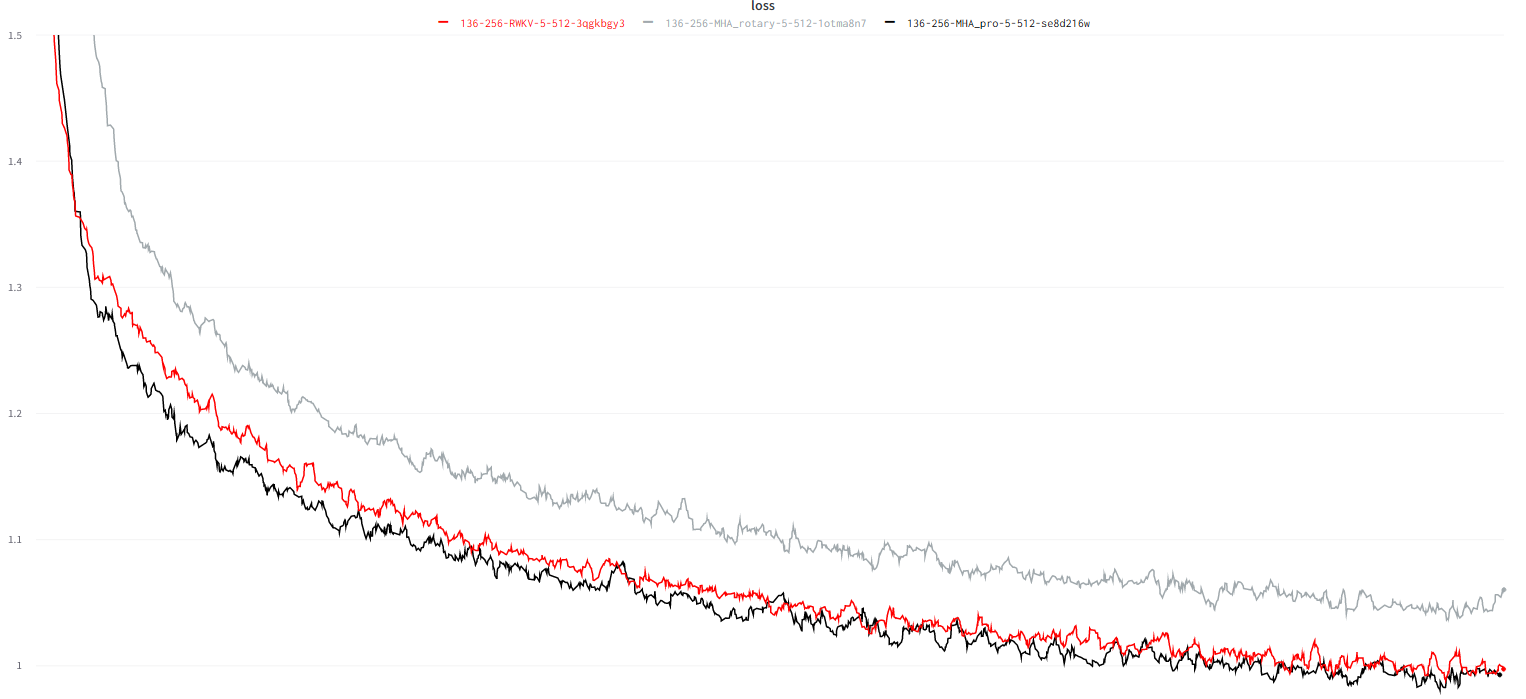
Gray: usual MHA+Rotary+GeGLU - performance not as good.
Red: RWKV ("linear" attention) - VRAM friendly - quite faster when ctx window is long - good performance.
Black: MHA_pro (MHA with various tweaks & RWKV-type-FFN) - slow - needs more VRAM - good performance.
parameters count: 17.2 vs 18.5 vs 18.5.